Monday, October 31, 2016

Amazon Brick & Mortar—No Fooling!

Ever browse in a bookstore, then look online at Amazon.com on your personal device to see if you can get the books for a cheaper price? You really shouldn’t do that, since it could drive your local bookstore out of business.

But now you can have the same experience guilt-free at an Amazon.com bookstore I visited on foot. No, this was not some virtual experience. This physical store in Seattle’s University Village Shopping Center is one of only three they’ve built.


Inside, they have typical bookshelves. I looked over the science fiction and fantasy selections and saw they were noticeably different from what I see in the three Barnes & Noble bookstores I frequent. That’s because they base their selections on rankings on the Amazon.com website—obviously.

Each book has two prices: For instance, the list price for this paperback Alexander Hamilton bio was $20.00. But if you were an Amazon Prime member, you would pay the online price. Currently, that is $13.27.


I don’t think this is simply a way of driving people to become Prime members—it would be a hideously expensive way to do so. No, many people want to feel a book, weigh it in their hands, and leaf through it before buying.


But at some point in the sick, twisted mind of Jeff Bezos, did he plot on driving other brick and mortar stores out of business, to be replaced by his own? When he saw Borders go through its death spiral, did he know his secret plan was working? 

Tuesday, October 25, 2016

No Helicoptering of Children

Not long ago, I saw parents escorting and staying with their elementary school children at bus stops. This is called helicopter parenting, a riff on how they’re said to hover over them.

This is not good for children. In ninth grade, I had to walk two miles to school. Part of it was up a steep hill. Here it is nowadays, with improvements.


It sure didn’t look this way back then. The steps were dirt, which turned to mud the first day I had to hike up it. Many of the girls were quite in distress over it. Later, they added crude steps in the form of railroad ties held in place by pipes that were hammered down. The pipes had no safety caps; just ends of pipes sticking up from the dirt or mud. We had to be careful not to jam our legs on them as we climbed.

Often I had to carry my alto saxophone case, which weighed thirteen pounds, in addition to my books.

Did I appreciate this at the time? No. Was it good for me? Looking back on it, yes. Not just in the sense of physical fitness, but in the sense of building character, which I now believe has to include physical challenges at a young age with no safety net. I never saw any parents escort their children up those steps. Now, parents drive their children to school when they could take the bus. I was shocked to find out some years ago that there were traffic jams around some schools because of how many parents dropped off or picked up their children from school.


But now look at that path. They have installed nice steps, instead of dirt. And there’s a railing. We didn’t need a railing as we toiled up and down with our books and musical instruments. 

Thursday, September 29, 2016

Can You Prove You’re Not Crazy?

Mitchell is a space navigator who wakes up in a mental ward with no idea why he is there. He overhears his captain saying to not let him remember what happened. Mitchell is told he has an incurable condition, so obviously he will never leave. But Mitchell knows he is not insane.


So begins “The Mind is its Own Place” by Carrie Vaughn, in this month’s September 2016 Asimov’s Science Fiction. (Sorry for the lateness of this post. If you can’t find this issue at your bookstore, you might try eBay.) Is Mitchell insane or not? The story is ambiguous at first, then the tension builds as he recalls bits of his memory.

I talked with Carrie Vaughn at the 2012 Worldcon in Chicago. She was very encouraging for my idea of a married vampire slayer. You can see an excerpt here, but of course, she’s not responsible for any lack of quality in my writing.

She wrote a young adult novel called Steel, and in the back is a helpful glossary on fencing terms. 

Wednesday, September 21, 2016

And then she turned into Seven of Nine

Last night, I dreamt I visited a friend to watch the winding down of a Sherlock Holmes TV series. I walked down to her apartment in a red brick building in England, and I sat beside her on a couch as we watched. There were no behind-the-scenes insights; just the last episode with Sherlock in his deerslayer cap. 
public domain
The scene changed to me by myself in a large auditorium, I think in California. I was there for the winding down of Star Trek background scenes. A large, flat image of the moon was against the high wall towards one end of the auditorium, and a few people from Star Trek, including DeForest Kelley who had played Doctor McCoy, were standing on a catwalk at that level for the occasion, smiling and apparently reminiscing about the old prop. 
photo by Alan C. Teeple
The moon was almost twice as tall as a person, and a large clamp at the end of a lift was set to take it apart, piece by piece. It grabbed hold of the bottom and pulled, making a middle flap start to tear away from the rest, so it was obvious it was composed of cardboard sections with the image of the moon spread on top, perhaps on a plastic sheet. This definitely ruined the illusion of it being so realistic.
But that section of the moon wouldn’t detach. Kelley and the others had to look at each other and amble around a little on their catwalk to make up for the lack of action.
With nothing happening, much of the crowd dispersed. I wandered on the bleachers towards the other end and found Jeri Ryan, who had played Seven of Nine in Star Trek: Voyager, sitting by herself. She was dressed in ordinary clothes and had her blonde hair down. I asked if I could sit next to her, and she said yes. 
photo by GabboT
We chatted as a couple men at that other end stood at the top of a ladder, obviously in a dangerous way, to dismantle some red metal framework that was as tall as a basketball hoop. One of the men got down from the ladder, then part of the framework fell near him. Part of it must have hit his arm, so he cried out in pain. This greatly disturbed Jeri Ryan, so she stared at him for several seconds, a look of great concern on her face.
A couple other celebrities came by. One of them was Sylvester Stallone, who asked me a question about Star Trek. When I tried to reply, he talked over me, making fun of Star Trek as if it were a silly subject for children. Resentful, I realized that behind him in the distance was a placard of some Neanderthal-like people, and I was tempted to make a comparison, but thought better of it. 
photo by Towpilot
After they left, a large scaffolding structure rose suddenly in the middle of the auditorium, effectively cutting the place in half. The people controlling it showed some of the effects they could do, like making part of it shoot it up so it looked like it reached the ceiling. They proceeded to dismantle it slowly, piece by piece.
I said to Jeri Ryan in an apologetic tone that this was all anti-climactic, after the failure to take down the moon.
The scene shifted to Seattle, and we were inside some kind of Star Trek museum. The first part was on the classic Star Trek, and she laid her hand on a tabletop display showing drawings of two starships. They were very similar to the original Enterprise, and she looked puzzled that the ships had a different name on it. I knew that the Enterprise was part of a fleet that had several ships of the same class, and I watched to see if she figured it out. She remained puzzled, and we moved on.
We went through a number of exhibits, then we reached the one on Voyager. I said, “This should be familiar to you.”
She was standing to my left, and for a moment she was in her Seven of Nine persona: hair wrapped around her head, a metal implant in place of an eyebrow, and her figure more pronounced because she was in her skintight silver uniform with a corset underneath. She said nothing but simply stared at an exhibit, implacably.
When I turned to look at her again after an instant, she was back to normal. 
(There are no copyright-free images of Seven of Nine. Here is the link:
To see my Giant Dream, click here. 

Friday, September 16, 2016

Not Killing Reagan

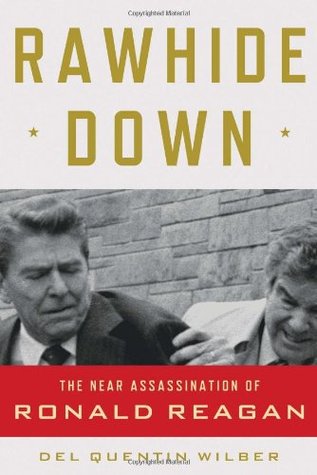
Since the attempted assassin of Ronald Reagan has been released, I’ll reprise my review of Rawhide Down from my original post, slightly altered at the start.

One of my picks for best non-fiction is Rawhide Down: The Near Assassination of President Reagan by Del Quentin Wilber. I remember when the news came in that President Reagan had been shot. On March 30, 1981, a gunman opened fire on Reagan with explosive bullets, one of which ricocheted off the presidential limousine and entered Reagan’s chest. Fortunately, it didn’t explode.


Reagan survived, but did you know:

-The Secret Service did not have professional training until relatively recently. That’s why during the Kennedy shooting the driver slowed down after the first shot, the way anyone would.
-When Reagan was in the OR, he took the oxygen mask off his face and quipped, “I hope you’re all Republicans.” This assured the nation that he was all right. In reality he was in great pain at that moment, and he had almost died.
-A doctor in the hospital responded to the call, looked the patient over, then was shocked when he saw the face. The patient was President Reagan. Then he realized there were all these men in suits standing around. 
-Another doctor was operating on the president. He looked up and asked if anyone else had been shot. What was going on outside? Had World War III started? The men in suits stared back at him, saying nothing.
-Nurses stayed with Reagan around the clock, often after their shifts were done. He passed funny notes to them, endless jokes and quips written in weak handwriting.

This is a fantastic book on a crucial moment in history. Wilber notes how professional the Secret Service was: In all the transcripts of their radio calls that day, they never said that the president was shot, or that Reagan was down. He had to be referred to by his code name of Rawhide. 

Friday, September 9, 2016

Fee, Fi . . . The Giant Dream

Last night, I dreamt.

At the start of my dream, I had crawled out of a cave below the edge of a cliff where I had hid, and now after a series of misadventures I stood on the top of the cliff.

I was standing at the edge of a gigantic corridor, much larger than for a human being. The walls, ceiling, and floor were of stone. At the end, to the left, was the opening to a huge lair. I sent a panel of stone, as tall as the corridor, sliding along the left wall to seal off the lair.

A fellow to my right grabbed and shook me with joy at what I was accomplishing. I had to caution him, because the panel was sliding so slowly.

Pale extremities of a huge nature began to emerge from the lair. Their odd shape gave evidence that the being who was emerging, whom I had tried to seal off, was not entirely human in form.

A gigantic cry sounded: “Fee, Fi, Fo, Fum.”

I turned and ran. Suddenly on all fours and in pain, I heard the rest. “I smell the blood of an Englishman.”

I had been half-awake, now I fully woke. I had rolled out of my bed and landed on a couple stacks of books.


Gustav Dore
public domain


This was not the first time a dream ended that way. See my Norweson/Nightmare entry.

Tuesday, August 30, 2016

Hosing Down Seattle – Review of Too High & Too Steep

Did you know the hills of Seattle used to be steeper than the hills of San Francisco? During the late nineteenth and early twentieth centuries, immense projects using water cannons washed dirt down from the tops of the hills. More earth was moved in these projects than in the digging of the Panama Canal.

Too High & Too Steep: Reshaping Seattle’s Topography by David B. Williams chronicles these projects in fascinating detail. Of course, the houses and other buildings on these hills had to be moved. The cover shows the “spite hills.” These were what were left partway through the project, when people were refusing to leave.


This is one of a number of real photos of the hills

The height of those leftover hills show the original height of that part of Seattle. For you locals, if you’ve ever puzzled over the term “Denny Regrade,” that’s where the term came from: Denny Hill in Seattle was regraded more than once. From the tallest point of the original Denny Hill, over one hundred feet has been removed.

Where did the dirt go? It was dumped into Elliott Bay, part of Puget Sound. Part of it makes up the land between Seattle and West Seattle. As you can imagine, geologists are concerned about that land slumping into Elliott Bay during an earthquake.

If you’re not familiar with Lake Union, it’s a sizable lake inside Seattle. It used to be landlocked. Canals were dug connecting it to Lake Washington to the east and Puget Sound to the west. When that happened, Lake Washington lowered dramatically. If you’ve ever shopped in University Village, it used to be underwater. Sand Point, which had a Naval base for a long time, roughly doubled in size. And people realized there was a nice beach on the Eastside suburbs of the lake, named it Juanita Beach, and tourists flocked there (though it is now part of Kirkland).

Back to flushing dirt off the Seattle hills. Was it worth it, to force those people out of their homes, to have this massive government project to lower the hills, and to dump the dirt into Elliott Bay? David B. Williams says no. Private enterprise, in the form of the motorcar becoming more common, would have made transportation on the hills fairly easy.


So it was a huge government boondoggle. We have something similar going on now, with massive tunnels being dug beneath Seattle for commuter trains, a project that is way behind time and massively over budget, though the private enterprise solutions of Uber and driverless cars are rendering that project obsolete. But that is another story. 

Thursday, August 18, 2016

Stranger Things – The Energy Department Rebuttal

I’ve never seen the Netflix series Stranger Things, starring Winona Ryder. Apparently some of it takes place in a sinister lab in a forest run by the Energy Department.

This got under the skin of Paul Lester, who runs one of the official blogs for the Energy Department. Uh oh.


Actually, Lester has a sense of humor, and he uses the series as jumping-off points to highlight the work of the Energy Department. He assures us there is no such sinister lab, but they do have one in the Argonne Forest in Illinois. It “was founded to continue Enrico Fermi’s work on nuclear reactors.”

The problem is, I remember watching a show on PBS about how Enrico Fermi was doing secret experiments in Chicago to make a nuclear reactor—in the city itself. He even had a man standing with an axe at a rope holding a bar of graphite. At Fermi’s signal, the man would cut the rope and the graphite would fall into the crude reactor, stopping a runaway reaction. Though if there were a huge burst of radiation, the man would die before he could cut the rope.

For all they knew at the time, a runaway reaction would have devastated Chicago.


So how assured are you feeling now? Nothing to see here? 

Tuesday, August 9, 2016

Steaming Coffee and Foie Gras Dream

Wait for the foie gras at the end.

Last night, I dreamt I was on-scene for a website that simulates everyday background noise to help a listener’s creativity.


photo by ToastielL

I sat towards one end of an open-air set of a coffee shop. About eight actors of varying ages acted out their roles in ordering coffee and other items while engaging in small talk. They gave their lines realistically, constantly in motion as they walked around the faux shop. I thought they were just going through a cycle of repeating each other’s lines, but they differed towards the end. They gradually left the set one by one, very noisily.

I could see across and to the left another set where a recording was going on at the same time. I cannot remember if it was a coffee shop, but it seemed to me that their voices would be picked up at a low volume for this coffee shop production, which would add to the atmosphere of ambient noise.

After the recording was over, the writer rested his elbows on the border of the far end of the shop, glasses on his brow. He leaned forward and let his forearms dangle, looking defeated. He spoke across the set to the producer, who was standing to the left of me. He asked, “Bad, eh?” referring to his writing.

The producer assured him he had done a good job. The writer seemed to be the typical sort involved in such productions—he mainly saw what frustrated him, not how well everything had worked.

After they left, I walked up to the interior corner of the set, near where the writer had been standing. I saw how realistic the fake brick and the arch for the entrance looked, and I wondered at my naïveté in thinking that the recordings were done in a real coffee shop.

I exited the set and saw to my left a number of sets for dinner parties. One of them was about to start production with a large family dinner party of perhaps ten people in a dining room, including adults and children, all in the stereotypical pose of holding their eating utensils upright in their hands.

This was a much more elaborate production. One person at the near end of the set announced he would call room service. (This made no sense, since it was in a home’s dining room.) He called up and ordered a dinner. At the end, he grabbed a pot and struck it against a surface to make a couple of clacking sounds, I think to hurry up service. Just beyond the far end of the set, I saw a man take a large stick and make clacking sounds at the same time, since that would be picked up by the mike more easily.

That done, a couple of chefs, complete with white chef’s hats, began preparing the dinner. They were also beyond the far end of the set, and a couple of them picked up a pair of immense geese. They squeezed the geese, making them vomit steaming foie gras into stainless steel pots.


photo of a Mulard Duck by Atlasroutier

My alarm clock went off, and the dream ended.
  
(For my Harry Potter dream, click here.)

LinkWithin

Related Posts Plugin for WordPress, Blogger...