I went to Doxacon, a Christian science fiction and fantasy
convention. It was on Saturday, Feb. 8th, in Woodinville, a suburb of Seattle.
Its name comes from the fact it was founded by an Eastern Orthodox priest.
Scenery outside
The attendance was somewhat over fifty, compared to a normal
six thousand for Norwescon or thousands more for Worldcon.
One of the volunteers running things was Megan.
The day started with a worship service, the Daily Morning
Prayer service of the Anglican/Episcopal Church.
Then, while people were getting coffee or tea or finding
their seats, a tall woman with long dark hair simply stood at her table. She
wore a black sheath with a couple of gold chains at her waist. She didn’t seem
to be looking for anyone, so that was puzzling.
She turned out to be SK Ehra, an author and the first
speaker. So she had been standing like that to get a feel for the audience. She
gave a lengthy, detailed lecture on science fiction, fantasy, and horror. She
granted that these can be forms of escapism. But they are a way of going beyond
the material universe to grasp truths that we know exist. She used illustrations
from a number of books to show such fiction can ask us hard questions about
ourselves.
She gave a defense of horror I had never heard before. When
horror is done right, it reflects different mental states. If I remember
correctly, a person haunted by a ghost may be having guilt for past sins. (Or
it could be bad memories. I apologize if I got that wrong.)
Afterwards, I went up to her and said that was the best
lecture I had ever heard on the subject, and I had been to many Norwescons and
Worldcons. Her lecture was so good because she emphasized the fallen nature of
the world.
The Writers Panel was composed of Reece Friesen, Tasha
Kennedy, Suzanne Hayek, Aaron Ryan, Rosamund Hodge, and Kevin King. Sorry, I
didn’t think to get a group picture. You might look up their books and see what
you think.
There were a number of other sessions, some similar to a
regular con, some very different. I’m glad I went and experienced something
different.
Dolly Parton has been in the news a lot recently. In October,
the State Department granted her the 2024 PEACE Through Music Award. Then in
November, she was #1 in Billboard’s 100 Greatest County Artists of All Time.
This gives me enough reason to reprise my 2020 post, Dolly
the Vampire Slayer.
________________________________
Or this could be called “Slay Belle.” So this is the
convergence between Dolly Parton, country music star, and Buffy the Vampire
Slayer.
Dolly Parton rocketed to fame with her hit song “9 to 5,”
which was the centerpiece of the 1980 movie of the same name. She became famous
not only as a country singer, but as a symbol of what nowadays is called female
empowerment.
Then there is Buffy the Vampire Slayer. This is the
TV series that jumpstarted the subgenre knows as urban fantasy. Were there some
urban fantasy novels before Buffy? Sure. But it was the Buffy
series that made urban fantasy an overwhelming subgenre in novels, movies, and
TV shows.
So how did that happen? It turns out Dolly Parton was an
uncredited producer of the original movie Buffy the Vampire Slayer.
That’s right. And Dolly’s company financed the TV series. It was Dolly Parton
behind it all the time!
But what if Dolly hadn’t done that? See my post What if Buffy had Never Been? to see how life as we know it would be different.
Meanwhile, you can see every season opening for Buffy below, including
the musical episode.
The long-time actor Donald Sutherland passed away on 6/20.
Most young people will think of him as the head bad guy in The Hunger Games
franchise. If he intimidates you, then good.
Such people might be surprised to know that before that, he
was generally viewed as a nice guy. One hotel worker said he was very humble.
He was so well-favored, for a long time his voice was used for a series of orange
juice commercials.
I remember him most for his role in Invasion of the Body
Snatchers (1978). He was the protagonist, so the audience was supposed to
be rooting for him. It’s not to everyone’s taste, but neither is The Hunger
Games franchise.
So I was sad to hear of his passing. He was quite the actor.
Freud’s Last Session.
Directed by Matt Brown. Written by Matt Brown and Mark St. Germain. Starring
Anthony Hopkins, Matthew Goode, Jodi Balfour. Rated PG-13 for language, sexual
material, bloody/violent flashbacks, smoking. Runtime 2 hr. 2 min.
Freud’s Last Session is a
fictional account: What if C.S. Lewis and Sigmund Freud met each other on the
eve of World War II? This would be just weeks before Freud’s death, and after
he was awarded the prestigious Goethe Prize for intellectual achievement. And
this was before Lewis’ radio lectures on Christianity during the war, which
became the basis for his famed apologetic work Mere Christianity.
Those who are looking for a
shootout between the atheist and the Christian will be disappointed. Freud
(Anthony Hopkins) does most of the talking. Lewis (Matthew Goode) mostly
listens. And thereby hangs an interpretation of the title.
Freud unloads on Lewis tirades not
just against Christianity, but often on his personal life. He strides around,
gesturing with his arms, dogmatic and arrogant. Lewis listens cooly, sometimes
sharing about his personal life when relevant, and giving mild rejoinders. In
the third act, Freud occupies the famous couch in his office, while Lewis sits
at the desk. Yes, this is Freud’s last session, with Freud as the patient.
The movie is disjointed, with a
rejoinder from either man sometimes much later than the question, and with
vivid flashbacks interrupting seemingly at random. So the following is a
stitching together of scenes that may not have been shown consecutively.
Lewis shares that after his mother
died, his father did not know how to deal with Lewis and his brother, so he
sent them off to boarding school. Freud concludes that the distant father led
Lewis to his superstitious longing for God. Lewis responds that actually, he
reconciled with his father. He then points out that Freud hates his father, so
perhaps that is why he rejects God. Freud dismisses that with a wave of his
hand.
Towards the start of the movie,
Freud criticizes Lewis for being late, seeing that as a flaw. However, Lewis
was late because of trains shipping children away from London to the safety of
the countryside. The compassion shows plainly on Lewis’ face as he sees the
children, and later when they both hear on the radio that twenty thousand are
dead in Poland. Freud shows no such reaction. But Freud is concerned about
those close to him—a daughter and grandson who died. He shows Lewis a
photograph of them. Freud asks about their deaths and his own pain and
suffering. Why does God allow it? And frankly, that is the question that most
non-intellectuals feel is most important about God.
At first Lewis says, “I don’t know,”
and Freud thinks he has a victory. But then it becomes apparent that Lewis was
talking about the particular suffering his family has gone through. Lewis goes
on to say that if pleasure is God’s whisper, then pain is God’s megaphone.
Freud constantly says Christianity
is just superstition, an "insidious lie," and at the start he says he is surprised an intelligent
man like Lewis believes in it. Later, we briefly see a flashback to Lewis’
writing group the Inklings, and we are shown an achingly short glimpse of a
page of Tolkien’s work. Tolkien witnesses to the then-atheist Lewis, saying the
Gospel is different from the world’s mythologies. He challenges Lewis to study
this. We then see Lewis doing so, going back to the original Greek of the New
Testament.
Fans of both Freud and Lewis will
be disappointed at some truncated versions of their arguments. Lewis says that
all the religions that Freud denounces teach about doing what is right and not doing
what is wrong. It leaves out Lewis’ argument that one can only know what is
wrong from a sense of right, can only know what is bent from knowing what is
straight, and that knowledge is what God puts in everyone. Freud gives a brief
mention of his belief in the stages of sexual development, but it is so garbled
by his oral cancer, it is hard to understand.
Freud is portrayed as getting the
better of Lewis over fear of death. During an air raid alarm that turns out to
be false, they go to a church basement for shelter. Freud not only shows no
gratitude, he is rude to the clergyman. But Lewis has a bad moment, which he
says was a flashback to The Great War. Freud needles him about that moment,
saying he showed no joy about meeting his God, and therefore Lewis had a lack
of faith. Lewis looks stunned for seconds, and he has no reply. Later, on the
train home, Lewis looks afraid again at distant lights that either remind him
of war or show the preparations for war.
Overall, Freud’s Last Session
has an unsavory air. Freud’s daughter Anna, considered the founder of child
psychoanalysis, is accused by more than one person of having attachment
disorder towards her father. This is shown in a series of flashbacks that turn
out to be beyond creepy. And the movie implies she had a lesbian relationship (which is shown briefly in a hallucination),
for which there is no evidence and which Anna always denied.
A lengthy flashback show the pact
between Lewis and a friend during The Great War, which Lewis did write about.
They both had single parents. If the friend were killed, Lewis was to take care
of his mother for the rest of her life, and if Lewis were killed, the friend
would take care of Lewis’ father for the rest of his life. The friend is
killed. In the most horrific scene of the flashback, hunks of shrapnel are
pulled out of Lewis’s leg without anesthetic. But when one puts together a few
scenes in the movie, it clearly portrays Lewis as having a sexual relationship
with his friend’s mother. There is no evidence for this.
So because of these and other
scenes, I cannot recommend Freud’s Last Session. Is this a biased
review? Perhaps. But were we all meant to interpret the movie the same way?
Unlikely.
Last year, I took a lot of pictures, which took a long time
to post. This year, I took much less.
Below, we see Batman and Robin getting photobombed by the
Penguin.
Torrey Stenmark is in her floor costume below. She has the
kind of light saber that sizzles. She recognized me, so she flicked it and made
it sizzle as she walked by, which startled me.
Here she is in her Masquerade costume. I asked her who her
character was. She asked me if I had seen Top Gun. I hadn’t, so I was a
little puzzled.
Norwescon was held at a hotel near the SeaTac airport. Here’s
a view with an airliner taking off in the upper left.
I should have said in yesterday’s post that Kimberly Unger
was one of the speakers on the subject of AI—or not really AI, just machine
learning.
Later, she won the Philip K. Dick award for best paperback
novel (science fiction of fantasy) published last year. Here she is with the award for her book, The Extractionist.
For me, the best event was a
workshop called “Plotting Your Novel with Save the Cat!“ A lot of people have
good writing skills. They can write interesting scenes. But they are told their
story structure will not attract readers. Our instructor, Emily Leverett, went
over in detail the best story structure that works over and over again, using
the book Save the Cat! Writes a Novel, by Jessica Brody.
As Emily Leverett emphasized,
this is not a matter of imposing a wooden template that gets rid of
originality. The story template comes from observing successful novels and
movies. It can be seen in stories as diverse as The Lord of the Rings
novels, the Star Wars movies, Jane Austen novels, the movie Legally
Blonde, etc.
As to what the phrase Save
the Cat! means, buy the book. It will do you good.
Emily Locke arrives as a new director at Wayne Security in Charmed
City, full of excitement and idealism about her new job. But she almost gets
killed before she can arrive at work. Why? Charmed City is ground zero for fights
between minor superheroes and supervillains. Emily’s train is derailed by a supervillain,
and the superhero Crimson Fox saves her and the rest of the train. Emily looks
like she’s going to explode with delight.
Wayne Security was founded by the distant Bruce Wayne. They try
to create products to help citizens protect themselves from supervillains (and
the fallout from superhero battles). Emily is raring to go with her team of
experts. Unfortunately, the Charmed City division is headed by a lesser cousin,
Vanderveer “Van” Wayne. He is shallow, obnoxious, stupid—everything that would
make a normal person quit. But not Emily. She constantly locks horns with Van, who
often doesn’t even get what the argument is about. But she usually wins—kind of.
What makes things worse for Emily are the three leading
specialists she has to work with. They are technical geniuses, but normally don’t
pay attention to what she says. Teddy is arguably the greatest genius, but is high
strung. He is depressed for almost an entire episode. Ron is easy-going—too easy-going
when a project needs to be done. Wendy is flat-out hostile to Emily, always
insulting her with a smile on her face.
Jackie is Van’s deadpan personal assistant. She started out
young and idealistic like Emily, so she constantly tries to discourage her.
Although, she is sometimes Emily’s ally. Jackie often gets in a good one to undermine
Van, without his being able to figure it out.
Everyone does a fantastic job in the show. The writing is
excellent, sometimes with good workplace humor, often with zany lines that come
out of nowhere. Usually the best scenes are between Emily—played by Vanessa
Hudgens, known from her role in the High School Musical franchise—and Van—played
by Alan Tudyk, known from his roles in Firefly and Transformers: Dark
of the Moon. Vanessa Hudgens is incredible. She goes through multiple extreme facial expressions every minute.
I say that Powerless is the funniest sitcom ever. Currently on The CW.
Kirstie Alley passed away at the age of 71. She was best
known for her long-running role in Cheers. But her breakout role was in Star
Trek II: The Wrath of Khan.
She played Lieutenant Saavik, a Vulcan. Kirstie Alley said
she had practiced arching one eyebrow for years, which she was convinced help her
land the part.
Saavik was unusual in that she showed a good amount of emotion
for a Vulcan, even shedding a tear at a funeral. This was later explained in the books
that she was only half Vulcan. Since this was never mentioned in the films,
that information is not considered canonical.
(Yes, the terms canonical and non-canonical come from how
Bible scholars refer to the books of the Bible as canon—coming from a Hebrew
word for a measuring rod—and other ancient religious texts as not canon. In Star
Trek, the TV shows and movies are canon, while the books are not. Are we
clear?)
So Kirstie Alley will be remembered for a number of roles
she played, but many fans will chiefly remember her for the unique spin she brought
to a Star Trek character.
The new Barnes & Noble at Crossroads Mall in Bellevue (a
suburb of Seattle) advertised that they would have Sasha Peyton Smith speaking
about her second book, The Witch Hunt. I have to admit that I wasn’t
familiar with the book. But it’s been a long time since I had heard an author
speak in person about a book, so I went. I’m glad I did.
Sasha Peyton Smith is on the right
Rachel Griffin on the left
Some authors do readings of their work, and then answer
questions as if the characters are real. In this case, Sasha Peyton Smith was
interviewed by Rachel Griffin, a fellow author. The interview was entirely about
the writing process. Sasha Peyton Smith discussed the research she did for the
two time periods and the two locations for her books—New York and Paris. An
interesting insight was she did not start writing her first book with the goal
of publishing it. She was just writing to please herself.
When she decided to try having it published, she said she
assembled a Frankenstein’s monster from parts of twelve different drafts. She
then submitted it with a badly written query letter. Despite all that, her first
book was accepted, and now she has her second book out.
While Sasha Peyton Smith was signing books, I asked Rachel
Griffin, author of the recent Wild is the Witch, about agents. She said
she submitted her first book to seventy different agents before she was
accepted. That process took about a year. She could tell I was an aspiring author
from my questions, so she wished me well.
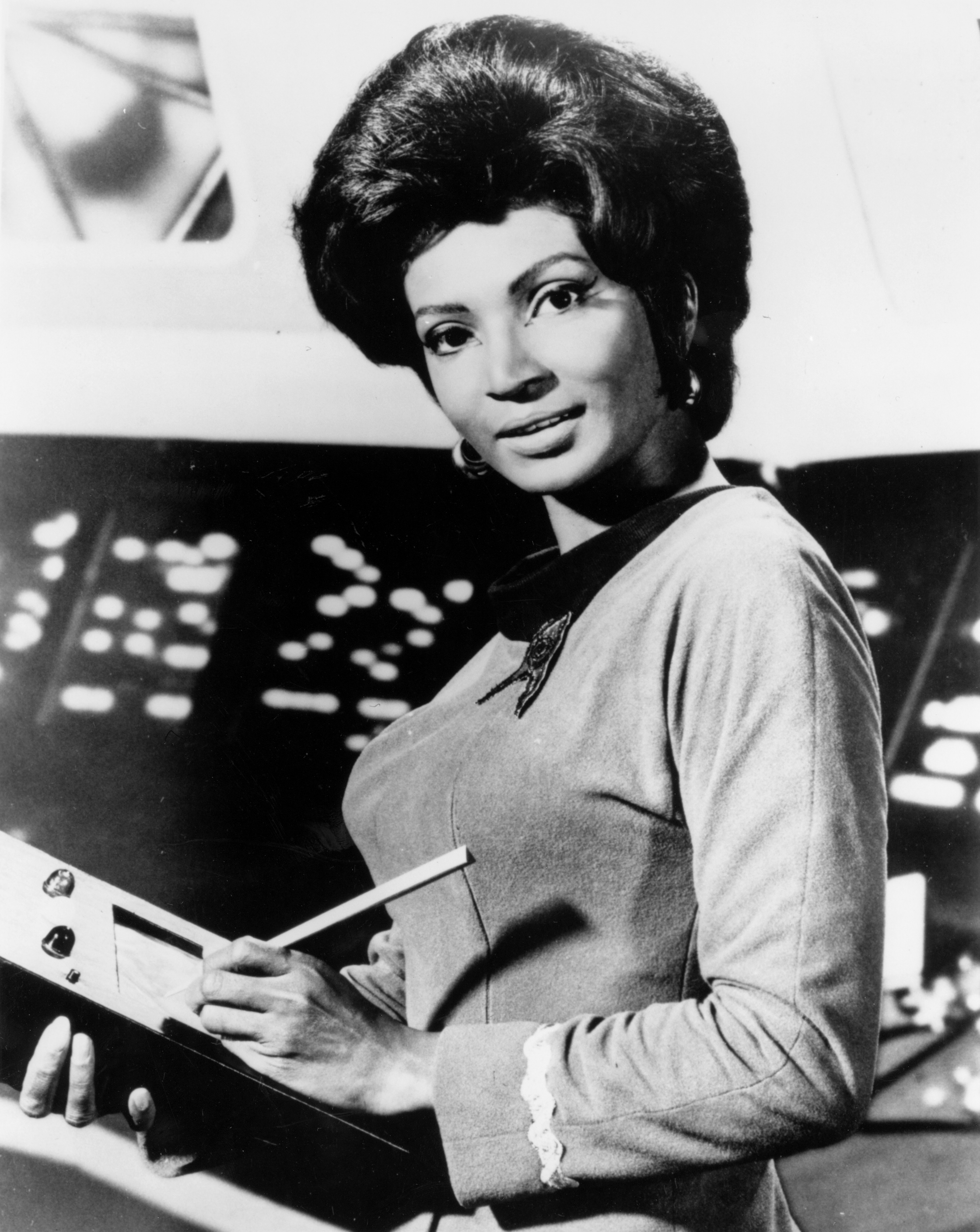
Nichelle Nichols, who was the original Uhura in Star Trek,
passed away. You can read all about her at various sites, but I’ll try to put a
unique spin on my comments. The Uhura who was played by Nichelle Nichols was
African, not African-American. This could be seen from her easy facility with Swahili
and the décor of her quarters. It could be argued that she might have been an aficionado
of African culture, but the original series was obviously trying to impress on
us that she was from Africa.
The Uhura in the new movies, played by Zoe Saldana, is
obviously African-American. She acts like a typical young woman raised in
America. Except for her name, she could have been a Caucasian, Hispanic, Asian,
etc. character, and there would have been no difference.
The Uhura in the new series Star Trek: Strange New Worlds,
played by Celia Rose Gooding, is definitely African, not African-American. How do
I know? Watch the series.
public domain
And just to put my own self-serving spin on things, I had a
short story published in Star Trek: Strange New Worlds Vol. 5 some years ago.
How could this be? Was it time travel?
Norwescon is the largest science fiction and fantasy
convention in the Pacific Northwest with an emphasis on writing. They capped
their in-person membership at one thousand this year, less than half their
usual. This was much better than last year, when it was all virtual—obviously. And
it was much better for me, since I could find parking spaces at the hotel and
pay the convention rate instead of the sky-high prices in the parking garages.
As usual, a Dalek was hanging around.
I assume it could exterminate its way into the parking lot.
And Iron Man could always jet in.
Cat Rambo was the Writer Guest of Honor. She has given me
helpful advice in the past on writing. She actually remembered me, which was surprising.
They also started the Norwescon Speculative Film Fest, which
they hope to make an annual event. They showed short films from around the
globe. I stayed long enough to see one from Japan about virtual reality and one
from France about something mysterious killing sheep—is it human or something
else?
One of the nice features of Worldcon is the opportunity for
autographs and Kaffeeklatsches. It took a while to figure out where the
autographs were being done—way in the far corner of the main floor, beyond all
the booths selling books, necklaces, samurai swords, etc.
Carrie Vaughn was there. She autographed my copy of her
young adult Martians Abroad, being careful to ask if my name ended with
a c or a k.
I thanked her for a brief conversation some years ago that
she probably doesn’t remember, when I asked her if there were many urban
fantasies where the female protagonist starts out already married. She couldn’t
think of any off the top of her head, but she encouraged me to try. I was
already working on my vampire parody with the current working title Dust after Slaying, so that was encouraging.
Mary Robinnette Kowal was also there. She had given me a lot
of advice several years before, and had made a point of talking to me at a
Worldcon some years ago. I said I didn’t know if she still recognized me, and
she said, “Of course!” What was embarrassing was that I had brought The
Calculating Stars, and while waiting in line I discovered that she
already autographed it.
I told her I have a Victorian fantasy manuscript, and the
female protagonist is a fairy who only learned to read as an adult. I use that
as a way of explaining some of the Victorianisms she sees around her for the
benefit of the reader. I asked if that would be a problem for readers, to have
the female protagonist being somewhat ignorant, though observant. Mary
Robinnette Kowal said no, so long as her emotions on encountering some new
thing are included. Ah. That was a key insight.
The Kaffeeklatsches are small meetings of up to ten people.
Attendees are encouraged to bring coffee, tea, soda, etc. Signups are ahead of
time, and one must inquire redundantly about where the signup sheets will be,
and how far ahead of time one can sign up.
I attended one with Cass Morris, author of From Unseen
Fire, an alternate history version of ancient Rome. She told us how laborious
the process was for getting it published.
She also specializes in rhetoric, and she was throwing around
terms like antanaclasis and anadiplosis quite easily. Her novel has multiple viewpoint
characters—a scene in a chapter might be told from one character’s point of
view, then after a brief line break the scene shifts to another character’s
point of view. She said her publisher did not have a problem with that. That was
a relief to me, since my recent science fiction manuscript Alpha Shift
has multiple viewpoint characters.
There are good panel discussions at conventions like this,
but try to find a way to get personal advice.
Worldcon—a large science fiction and fantasy convention that
a lot of writers go to—was held in Washington, DC This year. I had never been there
before. As we flew in for arrival, I realized we were passing what was
obviously the Pentagon. I was astonished we could fly so close to it. Continuing
on, I could see the Capitol, then the Washington Monument. It was all coming
true.
I arrived in time to see the art show by Maurizio Manzieri,
who is from Italy. One of his pieces, of a spaceship, was chosen for this year’s badges:
The big treat for the evening was the showing of the
restored 1927 movie Metropolis, directed by Fritz Lang. There have been several
iterations of this combination of science fiction and social commentary. The
2010 version restored several minutes that were found in a copy in Latin
America. More recently, some computer work has helped fill in the gaps, since
some scenes were filmed as slowly as 12 frames per second.
This evening’s presentation featured new music by Ryako. She
composed and performed all the music herself. She was there to take questions.
In my next post, I may show pics from my sightseeing.
Mike Nesmith passed away yesterday. He was the de facto leader
of the pop group The Monkees. Before anyone says anything else, yes, that really
was them singing. Because of the group’s origin, and some bad lip-synching in “Daydream
Believer,” for instance, the rumor goes around that the four of them weren’t
real singers. But yes, Mike Nesmith, Peter Tork, Micky Dolenz, and Davy Jones
really were singing.
public domain
They burst onto the scene in 1966 with their TV show The
Monkees. It was a show about a fictional musical group. But yes, that was
them singing, see above. They went on tour after that first season. Massive crowds
of screaming fans showed up. A phenomenon of that magnitude hadn’t been seen since
the heyday of The Beatles. After that, they worked hard and became a real band.
Although Micky Dolenz had the voice that was most characteristic
of The Monkees’ sound, my favorite singer was Mike Nesmith. My favorite song of
theirs is “You Just May Be The One,” written by Nesmith with him as the lead singer.
For copyright reasons I won’t put in a link to it, but try to find a version
that just shows the band playing, and not goofy scenes with Peter Tork.
Now for a science fiction connection: Walter Koenig was
hired to play Chekov in the old Star Trek because the producers wanted
to get some of the female audience that liked Davy Jones. Koenig was mistaken
for Jones once in a restaurant and asked to sing.